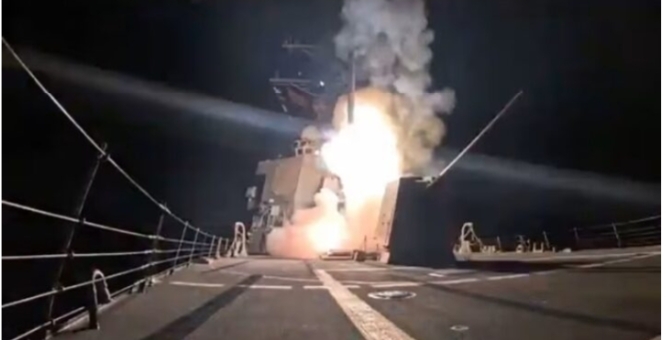
The reported air strikes carried out by the United States in Nigeria have continued to generate widespread debate and controversy across the country.
The development followed earlier warnings by U.S. President Donald Trump, who had indicated that military action could be taken against terror groups accused of perpetrating acts of genocide against Christians.
Against this backdrop, the reported launch of Tomahawk missiles—each said to be fitted with 1,000-pound warheads—into parts of Sokoto State did not entirely come as a surprise.
In the immediate aftermath, Nigerian government officials described the operation as successful, stating that it was conducted at the request of the Nigerian government.
However, this official position has drawn mixed reactions from the public and security analysts. Many have questioned the rationale behind requesting an air strike in Sokoto State, an area not recently known as a major hub of terrorist activity. Critics argue that if foreign military support was deemed necessary, such strikes should logically have been targeted at Boko Haram or ISWAP enclaves in the North-East, or at well-known bandit strongholds in Zamfara,Plateau, Kaduna and other parts of the North-West.
While the United States has also declared the operation a success, no concrete evidence has been made public to support this claim. This lack of transparency has further intensified skepticism.
As a media outlet, we believe there should be no secrecy surrounding an operation of this magnitude. If the air strikes achieved their stated objectives, the release of verifiable evidence should not pose a challenge. The failure to do so has inevitably fueled speculation regarding the motive, timing, and overall appropriateness of the strikes.
In some quarters, claims have even emerged that the missiles missed their intended targets and instead struck an onion farm. Although this allegation remains unconfirmed, it is unlikely to disappear without credible and convincing evidence to counter it.
Given the prevailing circumstances, it is reasonable to conclude that there may be more to the operation than has been officially disclosed. Particularly striking is the fact that the footage released by the United States reportedly shows only the launch of the missiles, with no visuals of their impact at the target location. This omission raises further questions.
One major concern raised by stakeholders is whether the Nigerian Air Force, assuming it had reliable intelligence about terrorist presence in the area, lacked the capability to carry out such an operation on its own. Our position is that the strikes were not beyond the operational capacity of the Nigerian Air Force. This was not a situation involving highly sophisticated or strategic threats that would ordinarily necessitate the use of Tomahawk missiles.
Some analysts have therefore suggested that the strikes may have served other strategic purposes, including possible weapons testing. While such views remain speculative, the opacity surrounding the outcome of the operation gives them some plausibility.
It is also noteworthy that this appears to be the first known instance of a foreign country conducting an air strike on Nigerian soil. This development presents troubling optics and leaves room for multiple interpretations. The United States must be careful not to appear overbearing in its support for Nigeria’s security efforts. This is not a case of total failure or paralysis on the part of the Nigerian Nigeria need help that can be seen clearly how this unwanted terrorist are dealt with.
Although the armed forces face operational challenges in certain theatres, these challenges do not amount to institutional incapacitation. Rather, Nigeria’s military struggles largely stem from technological gaps, especially in prosecuting asymmetric warfare, compounded by continued dependence on foreign sources for critical military hardware.
As a media outlet , we strongly advocate deeper intelligence sharing and technical cooperation between Nigeria and the United States. A more practical and sustainable form of assistance would be the provision of advanced Intelligence, Surveillance, and Reconnaissance (ISR) platforms to improve access to wide-area, real-time intelligence.
In our view, this approach is far preferable to unilateral air strikes. There are opportunities for constructive collaboration between both countries, many of which have been discussed over the years.
We also believe that unilateral military actions of this nature risk further complicating an already fragile security environment by introducing religious interpretations and heightening tensions within the polity. This incident should serve as a wake-up call for Nigerian authorities to intensify efforts toward building indigenous defence capabilities and strengthening national self-reliance.
Finally, we urge that the outcomes of the recently concluded African Defence Chiefs Summit in Abuja be carefully reviewed and translated into concrete actions aimed at enhancing defence capacity and addressing the numerous security challenges facing Nigeria and the wider African continent.





Post Comment