
By Jesse Nkwiri, The Nigeria Times
Last year when the rains finally arrived in Kpachudu, an Irigwe community, North-Central Nigeria, Bassa Local Government Area of Plateau State, 18-year-old Moses Dewe stood at the edge of his maize farm and watched the water run through it.

He had waited weeks for the first drop. The planting season had stretched longer than usual. When the clouds gathered, it seemed like relief was near. But within hours, the downpour flattened his crops and carved small channels across the field.
“Last year, the rain came too late,” Dewe says quietly. “This year, it came too much. Either way, we lose.” Dewe told The Nigeria Times after the success of the tournament on January 2, 2026

In many parts of Plateau, conversations about climate change are no longer confined to conferences or policy papers. They are unfolding on farms, in households, and increasingly, on football fields.
Across Irigwe land, farming remains the backbone of daily life. Most households depend on maize, potatoes, and vegetables grown on small plots. According to the Nigerian Meteorological Agency (NiMet), rainfall patterns across north-central Nigeria have become more erratic over the last decade, with delayed onset of rains and shorter growing seasons reported in several states, including Plateau. The Federal Ministry of Environment has also documented rising temperatures and increased frequency of extreme rainfall events in the Middle Belt region.
Local farmers say these shifts are visible.
“These days, we are uncertain about when to plant,” says Samuel Weyi, a community leader in Hukke. “If the rain delays, crops dry. If it comes heavily at once, it washes everything away.”
Plateau State has historically been known for its relatively temperate climate and agricultural productivity. Data from the National Bureau of Statistics show that agriculture contributes significantly to household income in rural Plateau communities. However, flooding in recent years has damaged farmlands in parts of the state, while prolonged dry spells have reduced yields. In 2022 and 2023, the National Emergency Management Agency reported flood incidents affecting several local government areas in Plateau, displacing families and destroying crops.

In Irigwe communities already affected by recurring violence and displacement, access to farmland has narrowed. Some farmers say insecurity has pushed cultivation closer to residential areas, increasing pressure on limited land. Youths who once farmed larger plots farther from home now rely on smaller, overused fields.
It is within this setting that the Plateau Green Football Tournament emerged.
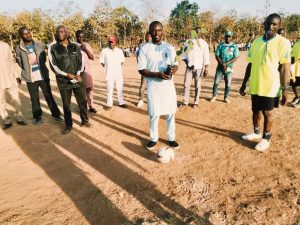
On a dusty field in Miango, young men in mismatched jerseys chase a ball across uneven ground. Spectators stand along the touchline, some shading their eyes from the sun. At first glance, it looks like any local competition. But alongside the goals and cheers are banners carrying messages about tree planting, biodiversity, clean energy, and waste reduction.
Hon. Nuhu Yakubu Chayi, Special Adviser to Governor Caleb Manasseh Muftwang on Sustainable Technology and Carbon Credit, helped initiate the tournament for the second time. He says the idea was to reach young people in a setting where they already gather.
“Football gives you access,” Chayi says. “It brings young people together without barriers.”
Twenty teams from different communities registered for the three-week tournament. Matches rotated across locations to encourage participation beyond a single village. Between games, short climate awareness sessions were held during opening ceremonies and finals. Organisers distributed seedlings of economic trees to players and spectators.
Samson Rivi, the coordinator of the initiative, says the approach was deliberate.
“Young people come for football,” he says. “While they are here, we talk about farming practices, tree planting, and waste. The messages are linked to their daily lives.”

Halftime breaks became moments for conversation. Organisers discussed how deforestation affects rainfall patterns, how improper waste disposal blocks drainage and worsens flooding, and how tree planting can reduce soil erosion. The messaging focused on practical steps—planting economic trees, protecting water sources, and reducing bush burning.
For Jephtah Araye, a player from Jebbu Miango, the tournament offered more than competition.
“With the knowledge of climate change, when we play, you stop seeing only opponents,” he says. “You see people you can work with.”
At the close of the tournament, each registered player received a tree seedling. Some spectators also left with seedlings in hand. A parent who attended the final match says she did not expect her son to return home with a plant.
“When I saw him carrying a tree to plant because he played football, I asked questions,” he says.
A Football administrator in the state says the connection between sport and social issues is not new. Suleiman Yahaya-Kwande, Chairman of the Plateau Football Association, says football has historically served as a unifying platform.
“Football is one of the strongest tools for engagement in our communities,” Yahaya-Kwande Wrote to The Nigeria Times. “When you bring people together around the game, you create space for conversation. If climate change is affecting the lives of young players and their families, football can help carry that message.”
He notes that many footballers in Plateau come from farming backgrounds.
“These are young men whose parents depend on the land. When harvests fail, it affects their education, their nutrition, and even their ability to participate in sport,” he says. “If we can use football to promote awareness and practical solutions, then we are responding to reality.”
Climate data indicate that Nigeria is among the countries vulnerable to climate variability. The Intergovernmental Panel on Climate Change (IPCC) has identified West Africa as a region likely to experience increased temperature extremes and variability in rainfall. In Plateau, local environmental groups report a gradual loss of tree cover due to fuelwood demand and land clearing for agriculture.
Flooding has also become more frequent in parts of north-central Nigeria. The 2022 nationwide floods, described by NEMA as one of the worst in recent decades, affected multiple states, including Plateau, damaging infrastructure and farmlands.
For young people in rural communities, these environmental changes intersect with employment challenges. The National Bureau of Statistics has consistently reported high youth unemployment rates nationwide. In agrarian areas, reduced farm output narrows income sources further.
The organisers of the Plateau Green Football Tournament say funding remains limited. Many volunteers contributed personal resources for logistics, transportation, and equipment. Some players walked long distances to attend matches. Security considerations were factored into scheduling and venue selection, with organisers consulting community leaders to avoid tensions.
The tournament does not claim to resolve the structural drivers of climate change. But on the fields of Irigwe, it has created a platform where climate information circulates in the local language, linked to lived experience.
As the final whistle sounded at the closing match, trophies were handed out alongside seedlings. Players posed for photographs, boots dusty, jerseys damp with sweat. Spectators drifted home carrying young trees.
On his way back to Kpachudu, Moses Dewe says he plans to plant his seedling near his family’s compound.
“If the farm fails again, we will still try,” he says. “But we can also plant trees.”
In Plateau, where rainfall patterns shift and harvests fluctuate, football has become one of the places where conversations about climate survival now begin.
Jesse Nkwiri is an advocate for Climate Change, community development, and good governance in Nigeria.


Post Comment