
By Palang Paul
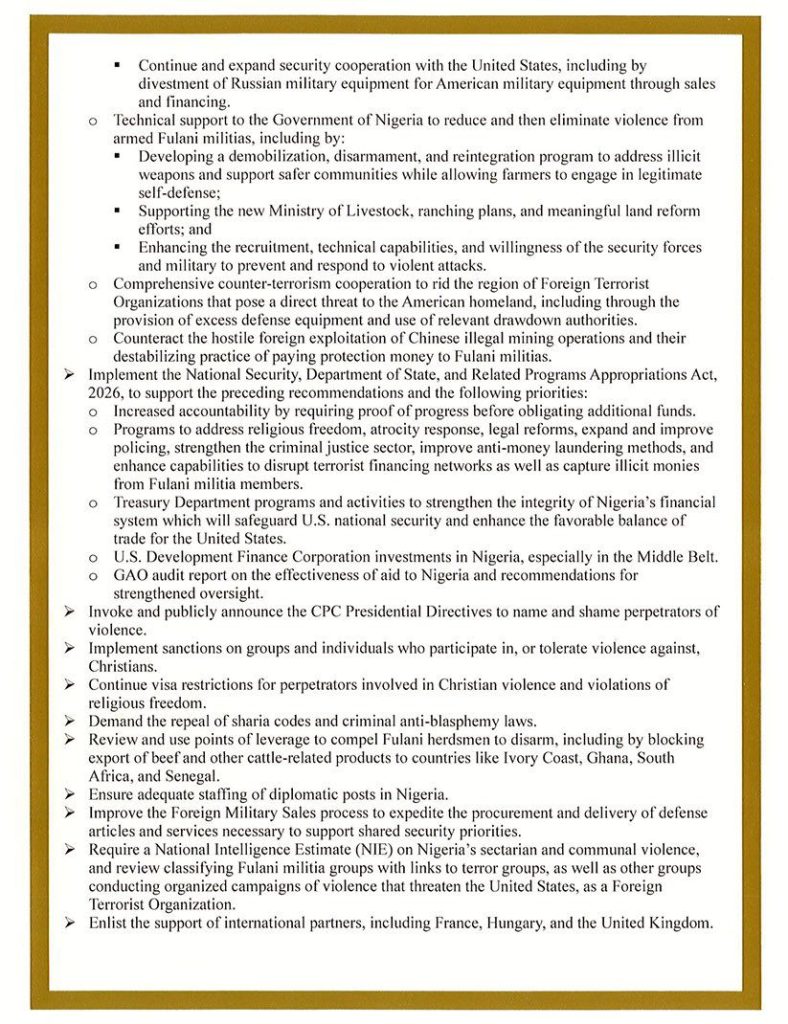
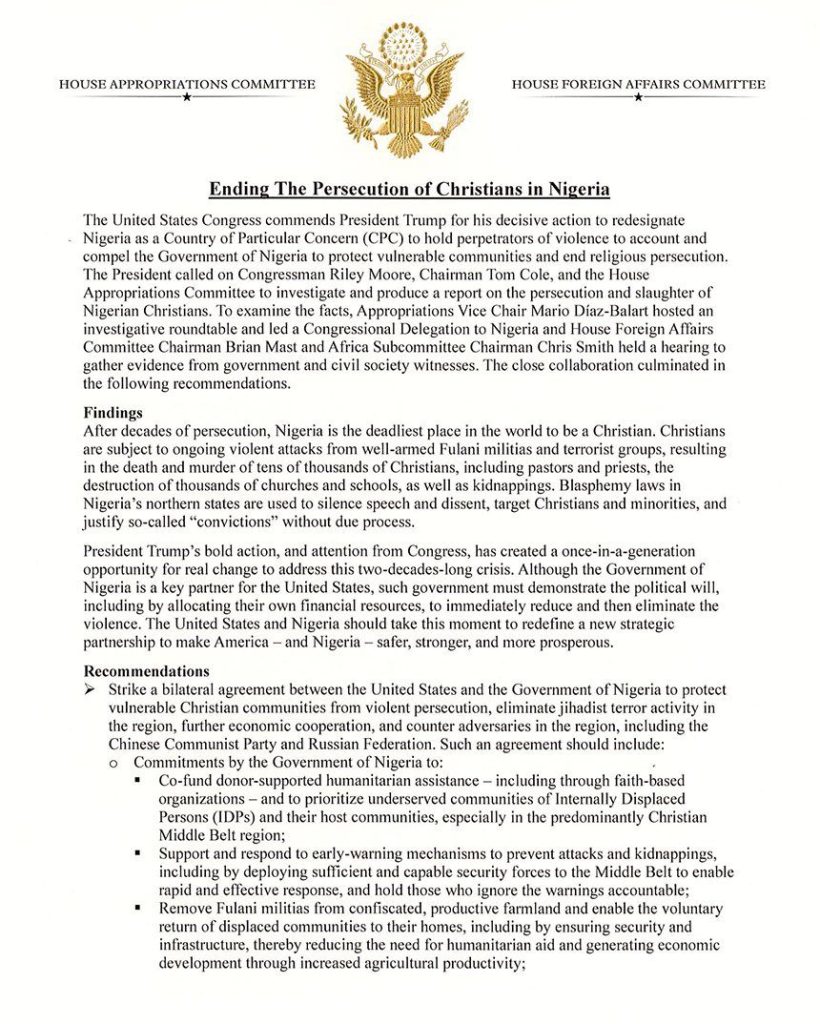
US Congressman Riley M. Moore has formally presented a congressional report to President Donald Trump calling for sweeping measures to address violence against Christian communities in Nigeria, including the repeal of sharia and blasphemy laws in parts of the country.
In a press release issued in Washington, Moore said he joined members of the House Committees on Appropriations and Foreign Affairs at the White House to submit what he described as a “comprehensive report outlining concrete actions to end the persecution of Christians in Nigeria and counter growing extremist violence in the region”.
The submission follows President Trump’s redesignation of Nigeria as a Country of Particular Concern (CPC) on October 31, 2025, under the US International Religious Freedom Act. Moore said the president tasked him and House Appropriations Committee Chairman Tom Cole to lead a congressional investigation into what he termed “the persecution against Christian communities and security challenges plaguing Nigeria”.
According to Moore, the report was the result of “months of investigation, including a bipartisan congressional fact-finding trip to Nigeria, hearings with expert witnesses, consultations with religious leaders, meetings with Internally Displaced Persons, and engagement with senior Nigerian government officials”.
“I travelled on a bipartisan delegation to Nigeria and saw with my own eyes the horrific atrocities Christians face, and the instability the Nigerian government must combat,” Moore said in the statement.
Findings
The report documents that after decades of persecution, Nigeria has become “the deadliest place in the world to be a Christian.” It cites ongoing violent attacks from well-armed Fulani militias and terrorist groups that have resulted in tens of thousands of deaths, including pastors and priests, the destruction of thousands of churches and schools, and widespread kidnappings.
The report specifically notes that blasphemy laws in Nigeria’s northern states “are used to silence speech and dissent, target Christians and minorities, and justify so-called ‘convictions’ without due process.”
Investigations included an Appropriations Committee roundtable hosted by Vice Chair Mario Díaz-Balart, a congressional delegation to Nigeria led by Díaz-Balart, and hearings chaired by House Foreign Affairs Committee Chairman Brian Mast and Africa Subcommittee Chairman Chris Smith, which gathered evidence from government and civil society witnesses.
Key Recommendations
The report calls for striking a bilateral agreement between the United States and the Government of Nigeria to protect vulnerable Christian communities from violent persecution and eliminate jihadist terror activity. Such an agreement would require Nigeria to:
· Co-fund donor-supported humanitarian assistance, including through faith-based organizations, and prioritize underserved communities of Internally Displaced Persons, especially in the predominantly Christian Middle Belt region
· Support and respond to early-warning mechanisms to prevent attacks and kidnappings, including by deploying sufficient security forces to the Middle Belt for rapid response
· Remove Fulani militias from confiscated, productive farmland and enable the voluntary return of displaced communities
· Continue and expand security cooperation with the United States, including divestment from Russian military equipment in favor of American equipment
The report also recommends technical support to help Nigeria develop a demobilization, disarmament, and reintegration program for armed Fulani militias, support for the new Ministry of Livestock and ranching plans, and enhanced recruitment and capabilities of security forces.
Countering Hostile Actors
A significant portion of the recommendations focuses on countering foreign exploitation, specifically calling on the US to “counteract the hostile foreign exploitation of Chinese illegal mining operations and their destabilizing practice of paying protection money to Fulani militias.”
The report also calls for comprehensive counter-terrorism cooperation to rid the region of Foreign Terrorist Organizations that pose a direct threat to the American homeland, including through the provision of excess defense equipment.
Accountability Measures
The report demands increased accountability by requiring proof of progress before obligating additional US funds to Nigeria. It calls for:
· Invoking and publicly announcing CPC Presidential Directives to “name and shame” perpetrators of violence
· Implementing sanctions on groups and individuals who participate in or tolerate violence against Christians
· Continuing visa restrictions for perpetrators involved in Christian violence
· Demanding the repeal of sharia codes and criminal anti-blasphemy laws
· Reviewing and using points of leverage to compel Fulani herdsmen to disarm, including by blocking beef exports to countries like Ivory Coast, Ghana, South Africa, and Senegal
· Ensuring adequate staffing of diplomatic posts in Nigeria
Intelligence and Designation
The report recommends requiring a National Intelligence Estimate on Nigeria’s sectarian and communal violence, and reviewing the classification of Fulani militia groups with links to terror organizations as Foreign Terrorist Organizations.
It also calls for enlisting the support of international partners, including France, Hungary, and the United Kingdom.
Next Steps
Moore emphasized that while the Government of Nigeria remains a key partner for the United States, “such government must demonstrate the political will, including by allocating their own financial resources, to immediately reduce and then eliminate the violence.”
The report states that President Trump’s action and attention from Congress “has created a once-in-a-generation opportunity for real change to address this two-decades-long crisis.”
“The United States and Nigeria should take this moment to redefine a new strategic partnership to make America – and Nigeria – safer, stronger, and more prosperous,” the report concludes.
More to come.


Post Comment