By Palang Paul
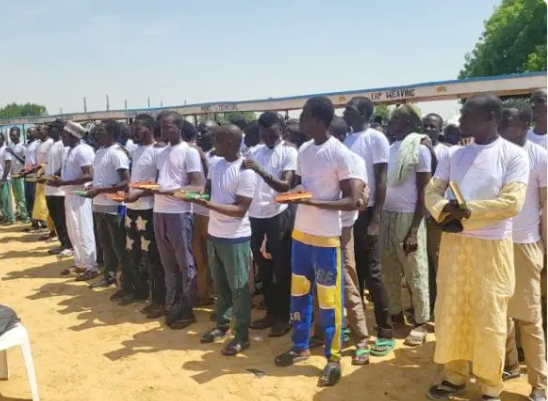
The Borno State Government has officially reintegrated 720 repentant Boko Haram fighters alongside 992 spouses and 2,050 children into local communities, sparking widespread public outrage.
This controversial exercise brings the total number of ex-insurgents processed and released through government deradicalization programs to nearly 10,000.
The Toll of Terror: Data and Devastation
For over a decade, the Boko Haram insurgency has laid waste to North-Eastern Nigeria, tearing at the socio-economic fabric of the region.
Lives Lost: The violence has caused over at least 38,000 deaths in Borno State alone, with thousands more across the wider Lake Chad region.
Economic Damage: In 2015, the World Bank estimated that repairing the devastation in Nigeria’s North-East would cost well over $9 billion. Projections indicate that without a permanent end to the violence, rebuilding costs could spiral to $30 billion
Displacement & Victims: More than 2.2 million individuals remain internally displaced, with many surviving in camps for internally displaced persons (IDPs) without any immediate hope of restitution. Survivors battle severe psychosocial trauma and crippling economic hardship.
The Reintegration Machine: Operation Safe Corridor
The return of 720 fighters—classified as “low-risk” minor clients—brings the total number of individuals processed through the national Operation Safe Corridor and local rehabilitation camps to over 9,000. The military-led initiative takes surrendered fighters through a 24-week program involving psychosocial therapy, vocational skills training, religious reorientation, and civic education.
Prior to their release, these former combatants are made to swear an oath on the Islamic Quran denouncing extremism and pledging allegiance to the Federal Republic of Nigeria.
A Nation Divided: Justice vs. Peace
Despite government assurances that these former combatants no longer pose a threat, the “trash” and controversial nature of the reintegration policy has provoked deep resentment. Affected communities and civil rights groups are openly rejecting the initiative, highlighting the stark inequality of the process.
While former insurgents receive vocational training, government-provided stipends, and a fresh start, victims of their atrocities remain confined to IDP camps with no financial restitution for their destroyed homes and lost loved ones.
Adding fuel to the fire is a pervasive, unverified public narrative that “repentant” insurgents are paid lump sums of ₦3 million and monthly salaries of ₦50,000. Critics and former soldiers also warn that such reintegration could serve as a cover for sleeper cells to infiltrate security agencies and gather intelligence for active insurgents.
What is the Government Doing?
The government’s response relies on a dual kinetic and non-kinetic strategy. While the military continues active operations in the Sambisa forest and surrounding regions to neutralize unrepentant elements, it defends the deradicalization program as a necessary peacebuilding tool.
State governments, including Borno State, are heavily investing in these demobilization, disarmament, and reintegration (DDR) processes, with Borno allocating ₦7.46 billion in its recent budget exclusively for the reintegration and rehabilitation of former fighters. Additionally, authorities have deployed monitoring and evaluation teams to ensure ex-fighters do not relapse into violence and to mediate their acceptance within host communities.
However, the question of whether this reintegration is a masterstroke for peace or a ticking time-bomb of injustice remains fiercely debated.
As Nigeria continues to invest billions in rehabilitating former terrorist, the challenge will be ensuring that victims are not reduced to an afterthought. Otherwise, a program designed to secure lasting peace may instead deepen resentment among those who paid the highest price for the insurgency.
The success of Nigeria’s deradicalization strategy may ultimately be measured not by the number of ex-fighters reintegrated, but by whether the nation can convince victims that reconciliation does not come at the expense of justice.


Post Comment