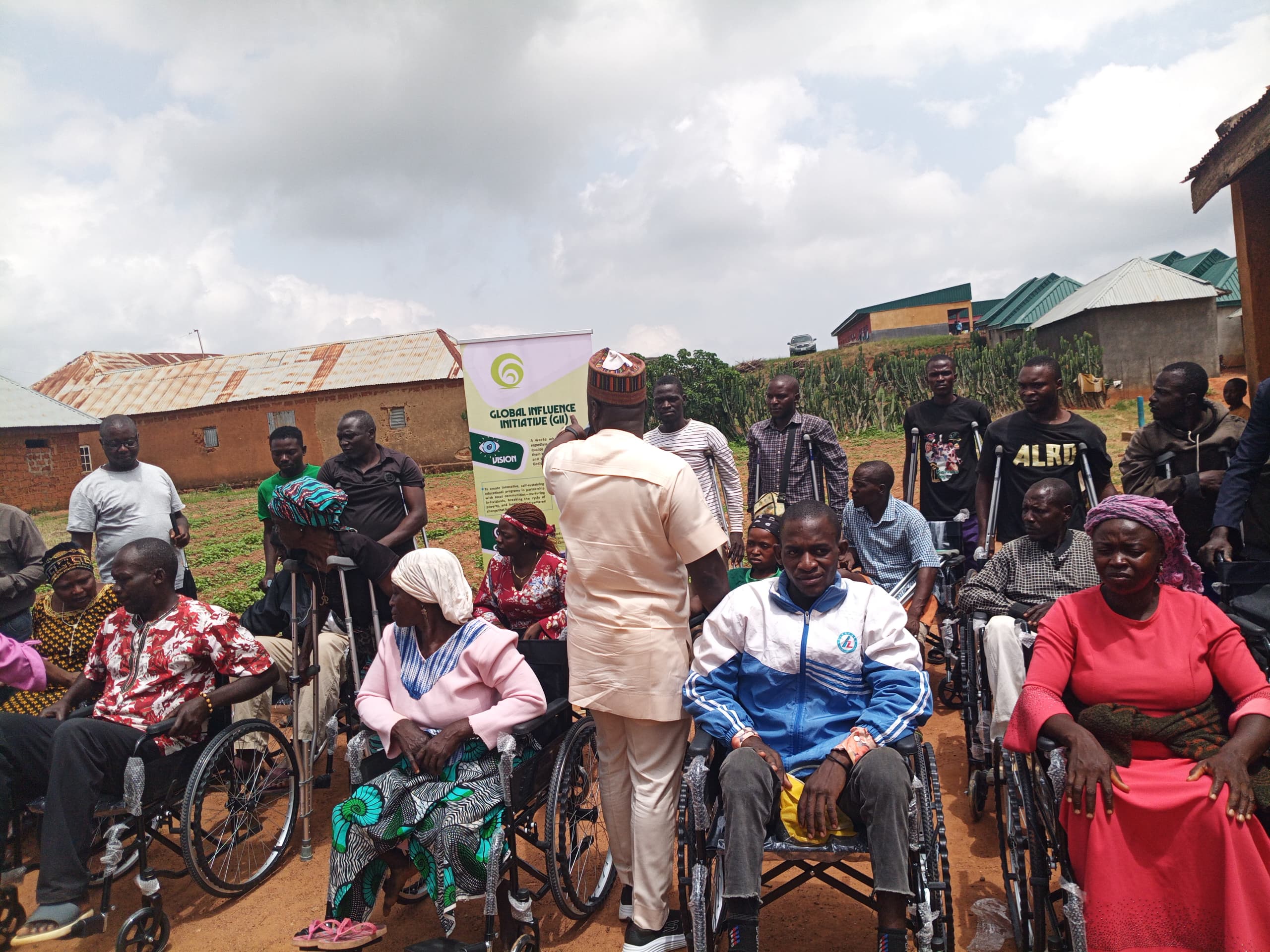
For nearly nine years, Elizabeth Anono watched life from the sidelines.
By Lawrence Zongo
The former classroom teacher, once active in her church and community, has been unable to use her legs since 2017. The condition ended her ability to work, limited her movement, and forced her to depend on relatives and well-wishers for daily support.

Today, a wheelchair sitting presented to her represents something she has not had in years: the ability to move independently.
“I can now go out again,” Elizabeth said. “I can attend church, visit friends, and do many things.”
Elizabeth was among several persons living with disabilities who received assistive devices during a disability inclusion outreach organized by the Global Influence Initiative (GII) in Kwall District of Bassa Local Government Area, Plateau State.
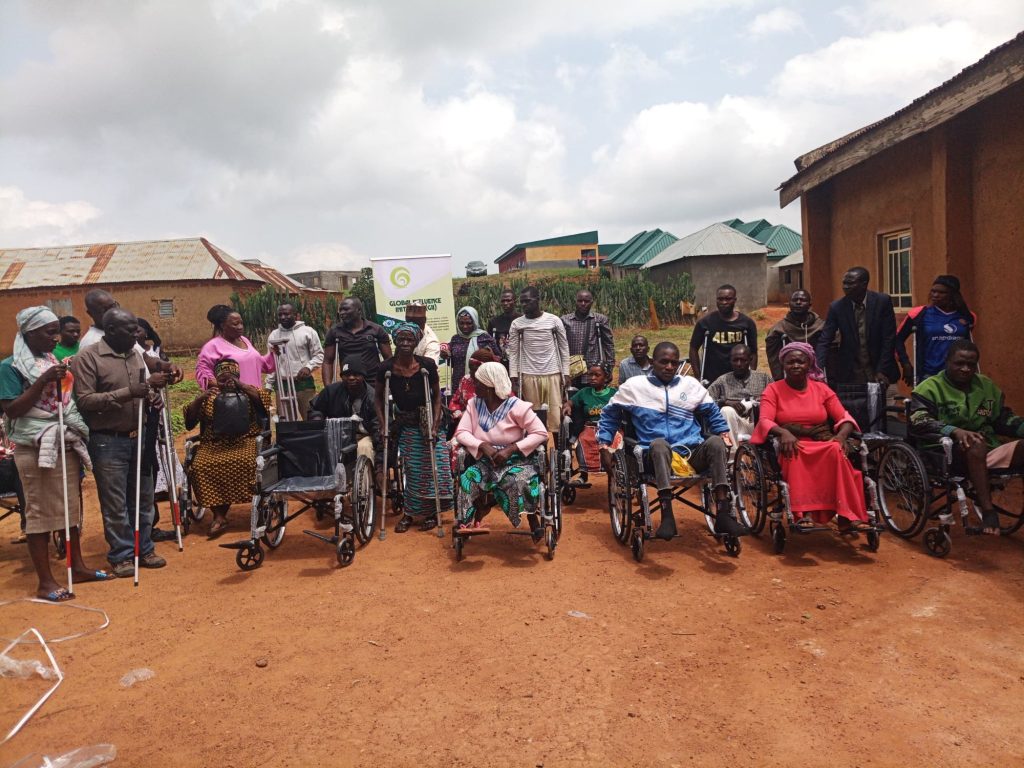
The distribution event, held at Qibla Global Influence Academy Oredam, brought together survivors of violence-related injuries, community members, and humanitarian workers focused on supporting vulnerable populations affected by years of insecurity in the region.
According to GII Country Field Manager Moses Gata, the program was designed to assist individuals who have sustained permanent injuries or developed disabilities following attacks in their communities.

“The recurring attacks in this area have left many people with lasting injuries,” Gata said. “Many now face challenges moving around, earning a living, and supporting their families.”
He explained that the initiative seeks to improve mobility and independence through the provision of wheelchairs, crutches, and other assistive devices, allowing beneficiaries to access public spaces and participate more fully in everyday activities.
For Elizabeth, the donation arrived at a critical time.
She said the wheelchair she previously relied upon had become damaged, leaving her with few options for transportation. Without employment, replacing or repairing it was beyond her financial means.
“The wheelchair I was using before was a gift, but it got damaged,” she explained. “I could not afford to repair or replace it because I am not working.”
The new wheelchair has already changed what she can do each day.

As a member of the choir at the Evangelical Church Winning All (ECWA), Elizabeth said one of the most difficult aspects of her condition has been losing the ability to participate in worship as she once did.
“I want to have my legs back so that I can dance and appreciate God,” she said.
Elizabeth continues to pursue medical treatment and said she hopes to undergo another surgery that doctors believe could improve her condition. According to her, the procedure would cost approximately ₦2 million, an amount her family has been unable to raise.
For years, she said, her husband carried much of the financial burden associated with her medical care.
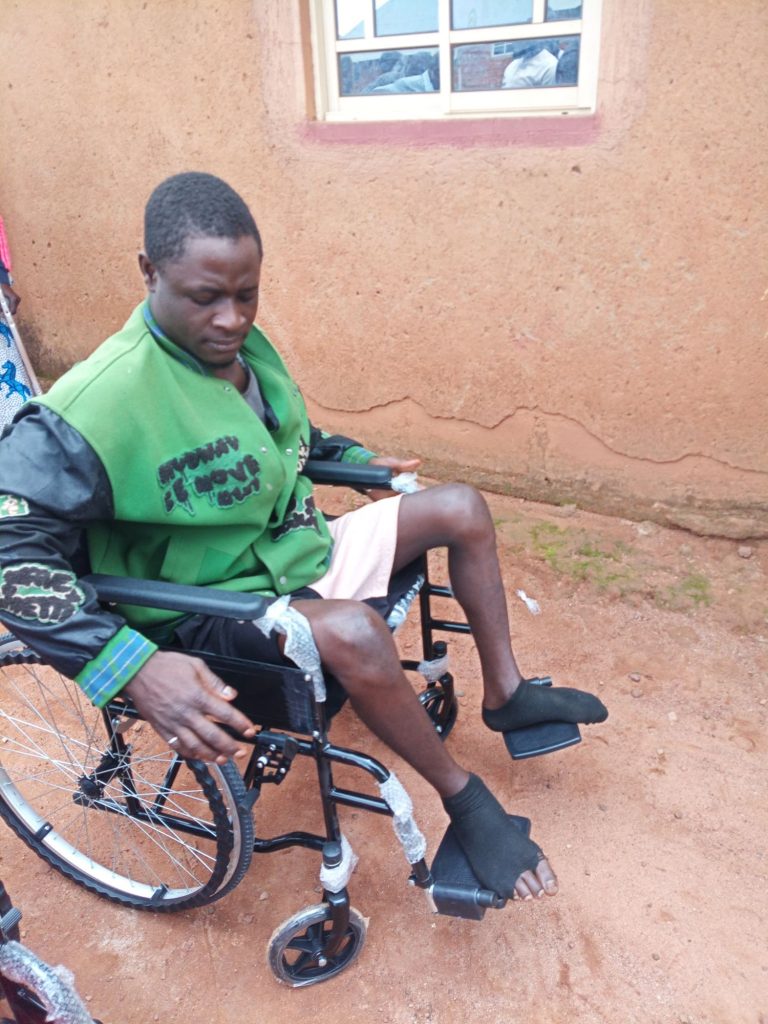
“This situation has affected us greatly,” Elizabeth said. “I can no longer work. As a classroom teacher, I have been forced to stay at home doing nothing, always depending on others for support.”
While she continues to seek assistance for treatment, she said the wheelchair has restored a degree of independence that had been missing from her life.
“I am grateful for this support,” she said. “This is another reason to smile.”
Across the gathering, similar stories emerged from beneficiaries whose disabilities have affected their ability to work, travel, and care for their families.
Speaking on behalf of recipients, Naomi David thanked GII for what she described as practical support for people facing daily mobility challenges.
“We are very grateful for these wonderful items that have been provided to support us,” she said.
David noted that many persons living with disabilities continue to struggle with transportation, employment opportunities, and access to income-generating activities.
“There are many things we still need,” she said. “Sometimes it is very difficult for a person with a disability to move around or engage in productive activities.”
A 45-year-old mother of three, David said, many beneficiaries are looking beyond immediate assistance and hoping for opportunities that can provide long-term financial stability.
She appealed for programs that support small businesses, farming initiatives, vocational training, and educational opportunities.
“If we receive financial support, we can engage in farming, start businesses, go to school, and learn various skills that will help us improve our lives,” she said.
Another beneficiary, Elizabeth Christopher, said the assistive devices will help recipients regain some independence in their personal and economic activities.
“I want to sincerely thank the Global Influence Initiative for providing us with wheelchairs and crutches,” Christopher said. “These items will greatly help us in our daily activities and businesses.”
Christopher, who survived a violent attack that left her living with a disability, said many affected individuals have received limited assistance despite facing long-term physical and economic challenges.
“We have not received much government support, so we are grateful to those who have come to assist us,” she said.
She added that many survivors lost their livelihoods after sustaining injuries that reduced their mobility.
“Many of us have lost our jobs and sources of income,” Christopher said. “We need support for our businesses and opportunities that will help us become self-reliant.”
Organizers acknowledged that the program reached only a portion of those requiring assistance.
According to Gata, the demand for mobility aids and disability support services remains significant across communities affected by violence in Plateau State.
Although beneficiaries welcomed the intervention, he said many other individuals are still waiting for assistance.
“We have seen the impact these devices can have on people’s lives,” Gata said. “But there are still many more people who need support.”
He appealed to development partners, charitable organizations, and private donors to help expand disability inclusion efforts in affected communities.
The Global Influence Initiative has increasingly focused on disability inclusion as part of its broader humanitarian and development work. The organization says its goal is to ensure that persons living with disabilities are included in programs designed to address the consequences of insecurity, displacement, and poverty.
For many recipients, the value of the devices extends beyond transportation.
Throughout the event, beneficiaries described being able to attend church services, visit markets, reconnect with friends, and participate in community life more regularly.
Some spoke about returning to small-scale business activities. Others discussed hopes of pursuing education, vocational training, or farming opportunities if additional support becomes available.
As the distribution concluded, wheelchairs and crutches that had been lined up at the venue were gradually put into use. Beneficiaries tested their new mobility aids while family members and community leaders looked on.
For Elizabeth Anono, the moment marked another step in a journey that began nearly a decade ago.
The challenges she faces remain significant, including ongoing medical needs and the cost of future treatment. Yet for the first time in years, she said, moving from one place to another has become easier.
Holding the handles of her new wheelchair, she reflected on what it would allow her to do next.
“I can go out again,” she said. “I can attend church, visit people, and continue with life.”




Post Comment