By Mike Odeh James, Abuja
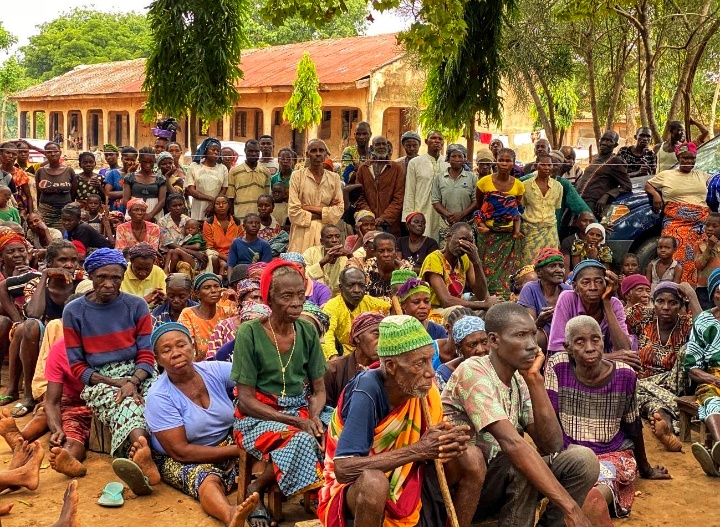
Hundreds of Christian villages in Nigeria’s Middle Belt have been seized, renamed and repopulated while the government looks away, a U.S.-based advocacy group charged Saturday.
In a formal letter delivered August 1 to Nigeria’s Minister of Defense, Gen. Christopher Gabin Musa, the United Middle Belt Development Forum (UMBDF), USA, accused the federal government of failing in its most basic duty — protecting its own citizens — and warned that the crisis engulfing the region has crossed “an alarming and critical threshold.”
The letter, addressed to Musa’s office at Ship House in Abuja and titled bluntly “Middle Belt Genocide,” is the latest sign that Nigeria’s diaspora is no longer waiting for Abuja to act. It is taking its case directly to the men who command Nigeria’s guns — and copying Washington’s growing file on Nigeria along the way.
A Letter to Ship House
The UMBDF’s central charge is dispossession on a massive scale.
“Hundreds of villages throughout the Middle Belt have been forcibly abandoned, with many subsequently renamed and their lands appropriated,” the letter states, citing corroborated reports from across the region.
Just as damning is what the group says has not happened. There is “a discernible lack of comprehensive governmental intervention at both state and federal levels to facilitate the secure and dignified return of these displaced indigenous populations to their ancestral homes,” the letter reads.
The group describes “unabated aggression, significant loss of life, and profound disruption of livelihoods” against indigenous, largely Christian communities, and warns of “potential cultural erosion” — the slow-motion erasure of peoples from lands they have farmed for generations.
Its demands are specific: “robust protection protocols” and “the allocation of necessary resources to ensure the security and survival of our imperiled citizens.”
The letter closes with a rebuke aimed at the heart of the Nigerian state. “The fundamental duty of any sovereign government is to uphold the safety and well-being of its citizenry,” the group writes. “We regret to observe that this foundational responsibility appears to be significantly unfulfilled in the context of the Middle Belt.”
The letter was signed by Diamond Longjel, Secretary of UMBDF USA, based in Elk Grove, California, and copied to the organization’s president, Dr. Nash Pwol.
EXPLAINER: Who Is the UMBDF?
The United Middle Belt Development Forum, USA, is a nonprofit formally registered in the United States, formed by Nigerians in the diaspora with roots in the Middle Belt — the fertile central band of states including Plateau, Benue, Kaduna, Taraba and Nasarawa. Its stated mission is to raise global awareness of human rights abuses and violence against the region’s Christian communities. Diaspora organizations like the UMBDF have become an increasingly influential channel between Middle Belt victims and Western policymakers, feeding testimony and documentation into U.S. congressional hearings and European parliamentary debates at a moment when Nigeria’s relationship with Washington is under unprecedented strain.
Villages Renamed, Lands Appropriated
The letter’s most explosive allegation — that seized villages are being renamed — echoes what TruthNigeria correspondents have documented on the ground for years.
Across southern Kaduna, Benue and Plateau, communities attacked by Fulani Ethnic Militia (FEM) describe a consistent pattern: armed assault, mass displacement, and then occupation. Survivors who attempt to return to farm find herds grazing on their fields and armed men in their homes. In Benue’s Otukpo County, TruthNigeria reported in July that Idoma Christian villages including Otukpo Nobi, Amla, Emichi and Okpomaju had been seized outright by Fulani Terrorists.
The renaming of captured settlements is significant because it signals permanence. A raided village can be rebuilt. A renamed village has been claimed.
EXPLAINER: Why Renaming Matters
Under international law, the forcible transfer of a population from its land, combined with measures preventing return, is a marker that distinguishes ordinary communal violence from ethnic cleansing. Scholars of genocide watch for exactly the pattern the UMBDF describes: displacement, occupation, and the erasure of place names — because names anchor a community’s legal and historical claim to territory. When a village’s identity is overwritten, its displaced inhabitants become permanent refugees in their own country, and the demographic map is redrawn by force. Nigeria’s federal government has never published an audit of occupied or renamed villages in the Middle Belt.
Why Musa — and Why Now
The choice of addressee is deliberate. Gen. Musa is not merely a cabinet minister; he is the face of the Tinubu administration’s newly muscular security posture.
In July 2026, Musa issued a shoot-on-sight directive against armed attackers — a dramatic escalation that critics, including this newspaper, read as an implicit admission of years of command paralysis while Fulani Terrorists overran Christian communities.
Days later, on July 23, President Bola Tinubu approved the largest restructuring of the Nigerian Army in decades: an expansion from eight to 12 divisions and 28,000 new personnel, with three of the four new divisional headquarters — Makurdi, Ilorin and Jalingo — pointed squarely at the Middle Belt.
The UMBDF letter lands, in other words, at the precise moment the government has conceded the region was structurally unguarded. The diaspora group is pressing the obvious question: expanded divisions may stop future attacks, but what about the hundreds of villages already lost? Who returns them, and when?
So far, neither the Defense Ministry nor any state government has announced a program to restore occupied lands to their displaced owners. The Kaduna State government’s disarmament committee has instead drawn criticism for offering benefits to repentant militants while victims receive nothing.
EXPLAINER: The Numbers Behind “Genocide”
The UMBDF’s use of the word “genocide” is contested in Abuja but increasingly common abroad. A six-year study by the Observatory of Religious Freedom in Africa (ORFA) documented 79,323 conflict deaths in Nigeria, attributing 44 percent of civilian killings to Fulani Ethnic Militia — a toll far exceeding that of Boko Haram over the same period. Genocide Watch has repeatedly republished field documentation from the Middle Belt. The U.S. State Department redesignated Nigeria a Country of Particular Concern on October 31, 2025, and the European Parliament passed a resolution on July 9, 2026, condemning the persecution of Christians in Nigeria. Whatever label one applies, the scale of the killing is no longer seriously disputed by independent monitors.
The Diaspora Pressure Front
The letter’s Elk Grove, California return address tells its own story. Middle Belt advocacy has gone international, and it is finding traction.
In Washington, the U.S. House has passed H.R. 8595, the FY2027 State Department funding bill, carrying an amendment by Rep. Greg Steube that would freeze 100 percent of American aid to Nigeria pending certification on religious freedom. A separate bill, H.R. 7457, remains in play. A U.S.-Nigeria joint working group convened in January, and congressional reports in February kept the pressure on.
Groups like the UMBDF supply this machinery with what it needs most: documented, first-person accounts from the villages Abuja prefers not to discuss. A letter to the Defense Minister is simultaneously a letter to Congress — a paper trail demonstrating that the Nigerian government was formally notified, in writing, of the scale of the dispossession.
If Musa’s office does not respond, that silence itself becomes evidence.
The Test Ahead
Gen. Musa now holds both the largest army expansion in Nigeria’s recent history and a written demand from the diaspora that he use it for its stated purpose.
The measure of the government’s seriousness will not be the number of new divisions on a map. It will be whether a farmer from a renamed village in Benue or southern Kaduna can walk home, rebuild, and harvest without fear — under the protection of the state whose “fundamental duty,” as the UMBDF reminded the general, is his safety.
Until that happens, the letters will keep coming. And so will the lists of villages that no longer bear their own names.


Post Comment