By TED EBUTE
There is something profoundly troubling about the recurring appearance of men dressed in ecclesiastical regalia during Nigeria’s election seasons, presenting themselves as Christian leaders and publicly lending their religious authority to political causes.

When people dress in the regalia or adopt the distinctive dress codes of a particular social, professional or religious group, the natural assumption is that they represent that group. Religious vestments, in particular, are not merely costumes. They carry symbolism, authority and identity. For Christians, ecclesiastical regalia are associated with offices, traditions and responsibilities within the Church.
This is why the emergence of self-styled “bishops” in Nigerian partisan politics deserves serious scrutiny.
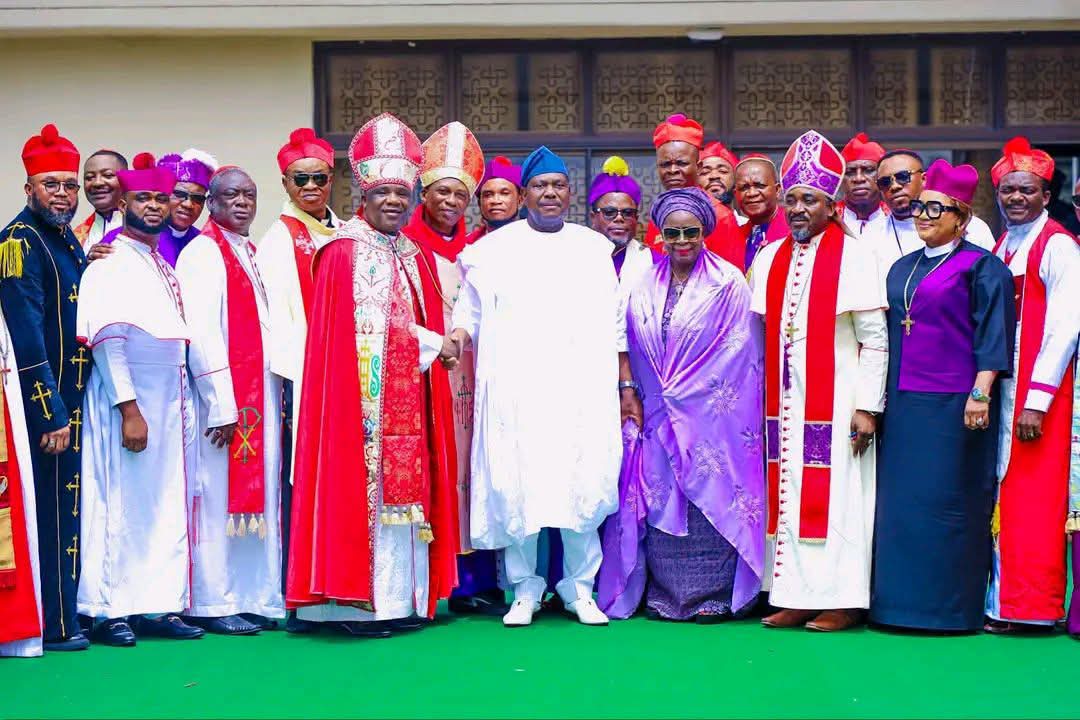
During the 2023 general-election season, Nigerians witnessed the now-famous episode involving a group of men dressed in what appeared to be episcopal or clerical regalia and publicly associated with the All Progressives Congress (APC) presidential campaign. Their appearance was widely questioned, particularly because many observers considered the regalia inconsistent with established Christian ecclesiastical traditions. Subsequent reports and images showing some of the men around a vehicle reportedly sharing money after the event only deepened public suspicion.
That episode should have been enough to make political actors and Christian leaders reflect deeply on the dangers of turning Christian symbolism into electoral theatre.
Yet here we are again.
Barely months before the 2027 general elections, another group of men described as “charismatic bishops” has reportedly emerged to endorse President Bola Ahmed Tinubu for a second term.
The question that therefore begs for an answer is simple but fundamental: Why does this particular political strategy repeatedly seem to require the presence of Christian bishops?
Why the apparent fascination with bishops?
Why is Christian clerical symbolism repeatedly being brought into the political arena, particularly when an electoral contest approaches?
And perhaps the more important question is: Who benefits from the appropriation of Christian authority for partisan political purposes?
Let me make it clear: there is nothing inherently wrong with a Christian, pastor, bishop or religious leader exercising his or her constitutional right to hold political opinions or support a candidate. Section 38 of the Constitution of the Federal Republic of Nigeria guarantees freedom of thought, conscience and religion, including the right to manifest and propagate one’s religion. Section 39 equally guarantees freedom of expression and the press.
Religious leaders are citizens. They have political rights.
But there is an important distinction between a Christian citizen exercising his political right and the deliberate deployment of religious office, symbolism and authority as an electoral instrument.
That distinction matters.
Nigeria is constitutionally a secular state in the sense that Section 10 of the Constitution provides that neither the Federal Government nor a State Government shall adopt any religion as a State Religion. At the same time, the Constitution protects religious freedom and prohibits discrimination on religious grounds.
The law therefore recognises both religious liberty and religious pluralism.
It is precisely against this constitutional background that the new provisions of the Electoral Act 2026 deserve particular attention.
Section 96(1) provides that political campaigns or slogans must not be tainted with abusive language that is directly or indirectly likely to injure religious, ethnic, tribal or sectional feelings. More significantly, Section 101 provides that a candidate, person or association that engages in campaigning or broadcasting based on religious, tribal or sectional reasons for the purpose of promoting or opposing a political party or candidate commits an offence. The provision carries substantial penalties, including fines and possible imprisonment for individuals, while political parties may face fines of between ₦30 million and ₦50 million.
The implication is significant.
Nigeria’s electoral law is increasingly recognising that religion should not become a weapon for mobilising voters or legitimising political candidates.
This should concern everyone—not only Christians.
The issue, therefore, is not whether a bishop has the constitutional right to support President Tinubu, Peter Obi, Atiku Abubakar or any other politician. He does.
The issue is whether religious identity is being deliberately packaged and deployed as an electoral commodity.
There is an even more troubling dimension to this.
When men who are not genuinely recognised by the Christian ecclesiastical structures they appear to represent put on episcopal-looking vestments for political events, they risk reducing sacred Christian symbols to political costumes.
That is not merely a political question. It is a question of the dignity of Christianity.
A bishop is not simply a man wearing a particular robe. Christian episcopacy carries theological, ecclesiastical and pastoral significance. The office represents spiritual responsibility, doctrinal authority and service to the Church. To reproduce its outward appearance merely to create a political spectacle is to risk turning sacred symbolism into theatre.
And Christians should be concerned.
We must also ask why political strategists appear to understand the persuasive power of Christian symbolism so well.
Is it because politicians believe that an endorsement presented by men dressed as bishops will carry greater moral legitimacy?
Is it because Christian imagery can soften the perception of a controversial political arrangement?
Or is there a deliberate attempt to communicate to Christian voters that the Church—or some supposedly authoritative section of it—has blessed a particular political project?
These questions deserve honest answers.
The 2023 presidential election already demonstrated how deeply religion can penetrate Nigerian electoral politics. The controversy surrounding the APC’s Muslim-Muslim presidential ticket generated intense debate among Christians and Muslims alike. It was therefore unsurprising that political actors sought various forms of religious reassurance and endorsement.
But democracy should not require counterfeit religious validation.
If a political party believes its record deserves another mandate, it should defend that record before Nigerians. Let it talk about the economy, insecurity, education, infrastructure, employment, poverty, corruption, constitutional reform and the rule of law.
Let politicians win elections through ideas, policies and performance—not through the theatrical appropriation of religious authority.
Indeed, the Electoral Act 2026 places a responsibility on political actors to keep electoral competition within lawful boundaries. Section 96 also expressly prohibits the use of places designated for religious worship for political campaigns, rallies and processions, and prohibits their use to promote, propagate or attack political parties, candidates or their programmes.
This is an important development.
The sanctity of the Church should not be subordinated to the ambitions of politicians.
But the responsibility does not belong to politicians alone.
Christian leaders must also look inward.
If politicians repeatedly find willing religious personalities prepared to lend ecclesiastical imagery and spiritual language to partisan campaigns, then the Church must ask itself difficult questions.
Who are these people?
Which churches do they represent?
Who consecrated them?
Which ecclesiastical authorities recognise them?
What gives them the authority to speak in the name of Nigerian Christians?
And when they endorse politicians, are they speaking for themselves or purporting to speak for Christianity?
These questions are not intended to deny anyone his or her political freedom. Rather, they are intended to protect the distinction between personal political choice and institutional religious authority.
The Constitution itself recognises the importance of equality and prohibits discrimination on religious grounds. Section 42 protects citizens from discrimination based on religion, among other grounds.
Consequently, nobody should interpret this argument as an attack on Muslims or Islam. Nor should Muslims interpret it as an argument that Christians should withdraw from politics.
On the contrary, every Nigerian—Christian, Muslim, adherent of African Traditional Religion or person of no religious faith—is entitled to participate fully in democratic life.
But participation must not become manipulation.
And religious faith must not become political merchandise.
Is Silence Always Golden?
This brings me to the Christian leadership.
For how long should genuine Christian leaders remain silent when Christian symbols are repeatedly dragged into political theatre?
Is silence always golden?
Or can silence sometimes become complicity?
There is a point at which the Church must speak—not in favour of one political party or another, but in defence of the integrity of the Christian faith.
Christianity should not be reduced to costumes at political rallies.
Bishops should not become props in electoral drama.
The Church should not become a campaign office.
And sacred symbols should not become instruments for manufacturing political legitimacy.
If the men appearing in episcopal regalia are genuine bishops, then their ecclesiastical identities should be transparent. If they are not, the Christian community has every reason to demand clarification.
Similarly, if political actors are sponsoring or facilitating such displays, Nigerians deserve to know.
This is not about hatred for the APC. It is not about support for the opposition. It is not about whether President Tinubu deserves another term. Those are legitimate political questions that should be debated separately.
This is about something more fundamental: the integrity of religious identity in a democratic society.
The APC, like every other political party, has every right to seek votes. President Tinubu, like every other candidate, has every right to campaign for another term. Christian citizens have every right to support him.
But political legitimacy should come from the electorate—not from the costume of a bishop.
And if politicians want the endorsement of Christians, let them seek it honestly from Christians, through dialogue, policy and performance, rather than through questionable displays of ecclesiastical symbolism.
Nigeria’s democracy is already sufficiently fragile. We do not need to deepen its fault lines by transforming religion into another battlefield for electoral competition.
Christianity must not be caricatured for political convenience.
Islam must not be caricatured either.
Neither faith should be reduced to an electoral costume.
The Nigerian people deserve better.
So do our religions.
And perhaps it is time for Nigerian Christians—especially recognised Christian leaders—to ask a simple but uncomfortable question:
When sacred symbols are repeatedly used to decorate political ambitions, who will speak for the sanctity of the faith?
Silence may sometimes be golden.
But on matters of principle, silence can also become complicity.



Post Comment