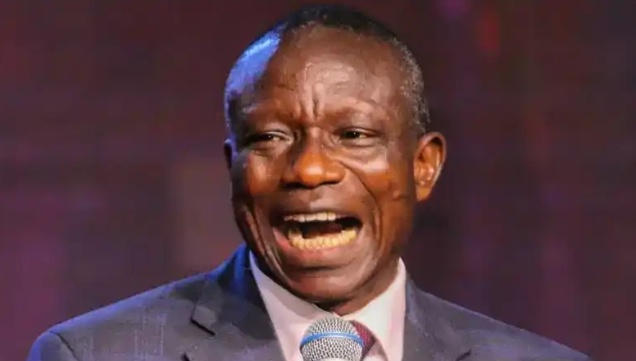
The National President of the Pentecostal Fellowship of Nigeria, PFN, Bishop Wale Oke, has vowed to resist any law restricting preaching in commercial buses, saying Christians would rather obey God than man.
Oke made the declaration while backing the Catholic Bishops Conference of Nigeria, CBCN, amid its recent disagreement with the Federal Government over insecurity, governance and the state of the nation.
The PFN president said any attack on the Catholic bishops amounted to an attack on the entire Christian community, stressing that the Church remained united despite denominational differences.
“Are we not bleeding in Benue? Are we not bleeding in Southern Kaduna? Are we not bleeding in Gwoza, in Borno State? Are we not bleeding in Kwara? Are we not bleeding in Oyo State?” Oke asked.
He argued that speaking truth to those in authority should not be interpreted as partisan politics but as a moral responsibility.
“Should anybody attack a Catholic bishop for saying that? That is the obvious truth,” he said.
Oke further declared: “The Church of Jesus Christ is one. There may be many denominations, but we have one faith, one Lord, one baptism. The Church is one. If they attack the Catholic bishops, they are attacking the whole Church.”
Oke Rejects Proposed Bus Preaching Restriction
The PFN president also condemned the proposed enforcement of a provision of the Federal Road Safety Commission Act that provides a penalty for preaching in commercial vehicles.
Although the Senate has clarified that the provision was not newly introduced but had existed since 2007 and was merely re-itemised, Oke insisted that it should be removed.
“We will break that law. Dear Senate of the Federal Republic of Nigeria, we will rather obey God than man,” he declared.
Oke said he had preached in buses since 1975 without causing accidents or distracting drivers, insisting that preaching the gospel should not be criminalised.
“If you want to imprison us for preaching the gospel, we are ready. If you want to make all the stadiums in Nigeria prisons, we are ready. We would rather obey God than man,” he added.
PFN Demands Nigeria’s Exit From OIC
Beyond the controversy over bus preaching, Oke called on the National Assembly to consider Nigeria’s membership of the Organisation of Islamic Cooperation, OIC.
He argued that Nigeria joined the organisation under military rule without the consent of the Nigerian people.
“The Senate should deal with that and pull Nigeria out of the OIC,” Oke demanded.
He also called for a review of the 1999 Constitution, alleging that it disproportionately references Islam while giving insufficient recognition to Christianity.
“In that Constitution, Islam is mentioned hundreds of times. Christianity is mentioned once. And Christians in Nigeria are a little over 50 per cent of the population,” he said.
Oke argued that the Constitution was imposed under military rule and should therefore be reviewed to reflect the wishes and interests of Nigerians.
Cleric Accuses Government of Ignoring Killings
The PFN president also accused the government of failing to adequately address attacks and killings in parts of the country.
He cited violence in Plateau, Southern Kaduna, Benue and Taraba, while also alleging the spread of violent groups into parts of Oyo, Kwara and Edo states.
Oke further maintained his position that Christians were being deliberately targeted in parts of Nigeria, describing the situation as Christian genocide.
He accused the government of spending billions of naira lobbying against such claims in the United States while killings continued in Nigeria.
However, his claims about the nature and scale of attacks were not independently established in the remarks.
Oke said the PFN was simultaneously engaging the Presidency privately over the issues but declined to disclose details of those engagements.
Apostolic Church Leader Questions Bishops’ Timing
Meanwhile, Pastor Seyi Osuntayo, Area Superintendent of The Apostolic Church Nigeria, Igbein Area, expressed concern over the public disagreement between the Presidency and the Catholic bishops.
Osuntayo said the timing of the CBCN’s intervention could be interpreted as partisan, particularly with the 2027 elections approaching.
“The timing of the Catholic Bishops Conference of Nigeria’s advice could be suspicious and be seen as partisan,” he said.
He argued that Christian leaders should focus on governance rather than becoming involved in political confrontations, citing 1 Timothy 2:1–4, which calls on Christians to pray for those in authority.
“Our leaders need prayer, whether we agree with their views and leadership style or not,” Osuntayo said.
He also criticised what he described as an increasing tendency among Christian leaders to use media platforms to attack the government, arguing that Christians could instead channel their concerns through prayer.
Journalist Accuses Government of Hypocrisy
However, journalist and author Ben Charles-Davies dismissed the confrontation between the Presidency and the Catholic bishops as unnecessary.
Charles-Davies argued that the government should focus on the economic hardship facing Nigerians rather than engaging in verbal exchanges with religious leaders.
“My simple response to the verbal exchange between the Presidency and the Catholic Bishops Conference of Nigeria is that it is unnecessary. The government is trying to divert attention from the main issue, which is poverty in the land,” he said.
He accused the government of hypocrisy, recalling that the CBCN had criticised the administration of former President Goodluck Jonathan in 2014 over economic conditions, with members of the then-opposition All Progressives Congress applauding the bishops.
According to him, the same party now appears uncomfortable with criticism from the bishops because it is in power.
Charles-Davies said government officials should exercise restraint when responding to prominent Nigerians who disagree with their policies.
“Nigeria belongs to all of us, not just those in government,” he said.
He also questioned whether government officials were giving President Bola Ahmed Tinubu an accurate picture of the country’s security and economic situation.
Commentator Accuses Catholic Bishops of Political Influence
A speaker, author and entrepreneur, Ugoji Maximillian, offered a contrasting interpretation, accusing the Catholic bishops of exercising significant political influence.
Maximillian, who said he was raised Catholic and attended a seminary, described the bishops as a powerful institution capable of influencing political outcomes.
“The Catholic bishops are a strong body. But they are highly political. They know how to play politics and can intimidate and threaten a politician using their structures,” he said.
He alleged that Catholic leaders had played influential roles in political developments across states including Enugu, Anambra, Imo, Benue and Kaduna.
Maximillian also criticised the bishops’ perceived political position ahead of the 2023 elections, alleging that they strongly supported Peter Obi and opposed Tinubu.
“In 2023, they made a wrong move. That wrong move backfired. They put their eggs in one basket. They went all out for Peter Obi. They showed clearly that they disliked Tinubu. But they masked it by saying they were against the Muslim-Muslim ticket,” he claimed.
Former Lagos Commissioner Defends Government’s Economic Record
Meanwhile, former Lagos State Commissioner for Physical Planning, Toyin Ayinde, offered a more positive assessment of the government’s economic reforms.
Ayinde argued that Nigerians often expect economic reforms to produce immediate results, saying meaningful changes require time.
“Nigerians don’t understand process, so everything must happen at microwave speed,” he said.
He cited his personal experience with banking transactions as evidence of improvements in financial access, saying he had used his naira ATM card to make an online payment of about £4,500 and for purchases while in Canada without relying on a dollar card.
Ayinde also criticised what he described as a culture of publicly shaming political opponents rather than offering constructive solutions.
“Rather than contribute advice for a guided way forward, we look for what to talk about in a disrespectful way to shame the other party,” he said.
The divergent views reflect the growing debate over the role of Christian leaders in public affairs, the government’s handling of insecurity and economic hardship, and the limits of religious expression as Nigeria approaches the 2027 general elections.


Post Comment