
By Lawrence Zongo
Residents of the Utono community in Ngaski Local Government Area of Kebbi State are gripped by fear after a chilling letter allegedly written by suspected Boko Haram insurgents surfaced on social media, openly threatening an imminent attack and demanding N100 million in cash as “zakat.” The letter, written in Hausa and dated February 17, 2026, has reportedly been circulating widely online, heightening anxiety among villagers who say they feel abandoned and exposed.
The threatening message, allegedly issued by fighters identifying themselves as “Jannatul Ahlussunna Lidda’awa wal Jihad,” a name historically linked to Boko Haram, was said to have been addressed to the district head of Utono and later shared among residents. Copies of the letter, now seen across various social media platforms, warn that the insurgents will storm the community at any time — day or night — to collect the demanded sum.
In the letter, the group instructed that the N100 million be gathered in advance and kept at the palace of the district head before their arrival. The insurgents also demanded that all cattle owners, both men and women, bring their livestock back from the bush to their homes for counting as part of the “zakat” enforcement.

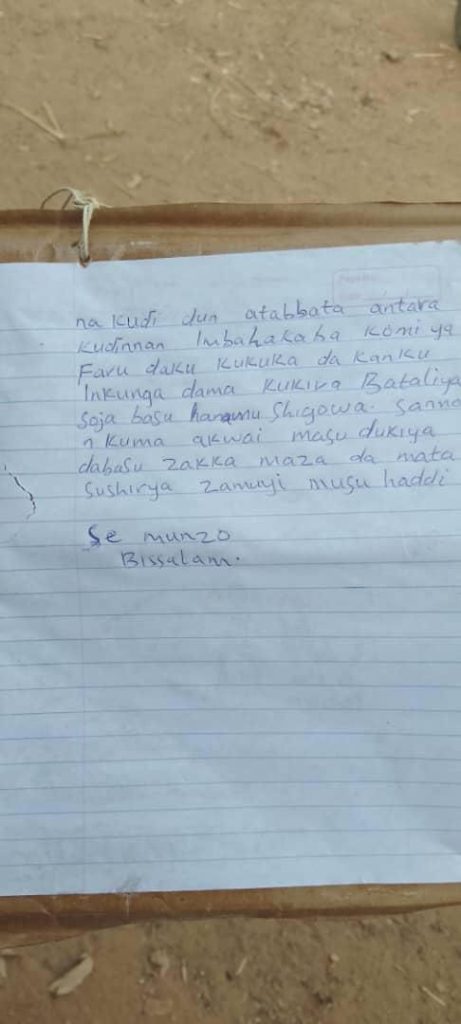
“Peace be upon you, the entire community living in the surrounding areas,” the letter begins. “We are informing you that the fighters of Jannatul Ahlussunna Lidda’awa wal Jihad are sending you this message of warning.”
The statement goes on to forbid residents from fleeing, declaring that any attempt to escape would attract consequences. “From now on, starting immediately, even if it is in the daytime, do not attempt to run away or flee. By the will of Allah, we will come whether it rains or not, whether it is morning or night,” the letter reads.
The insurgents further claimed that security forces would be powerless to stop them. “Even if you call soldiers, they cannot stop us from entering,” the message warned, adding that wealthy individuals who have allegedly failed to give “zakat” would face punishment.
Local sources told reporters that the circulation of the letter has created widespread panic across Utono and neighboring settlements. Many families, particularly women and children, are said to be living in constant fear of an impending attack. Some residents are reportedly contemplating fleeing despite the explicit warning from the terrorists not to do so.
Community members described the demand as devastating, noting that Utono is largely made up of farmers and livestock owners who depend on their cattle and farmlands for survival. The instruction to gather livestock for counting has particularly alarmed pastoralists who fear it may be a prelude to looting or mass seizure of animals.
“The amount they are demanding is impossible for us,” one resident reportedly said. “People are struggling to survive. Now they want N100 million and our cattle.”
The insurgents also instructed the community to contact wealthy indigenes living outside the area to contribute financially toward meeting the demanded amount, further compounding the distress of families already battling economic hardship.
Observers say the boldness of the threat — especially the claim that the Nigerian Army would be unable to intervene — has deepened concerns about the security situation in remote communities. Residents reportedly feel vulnerable, particularly given previous incidents in parts of northern Nigeria where armed groups have imposed levies or attacked villages that failed to comply with financial demands.
As of the time of filing this report, there has been no official statement from the Kebbi State Government or security agencies confirming the authenticity of the letter or outlining measures being taken to protect residents of Utono.
The absence of immediate public reassurance has intensified anxiety among locals, who say they are waiting for visible security deployment to deter any potential attack.
For now, fear hangs heavily over Utono, as families weigh the terrifying choice between staying under threat or fleeing into uncertainty — while a letter circulating online continues to cast a long shadow over the quiet farming community.



Post Comment