By Moses Gata

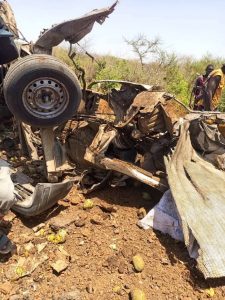
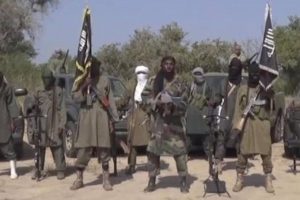
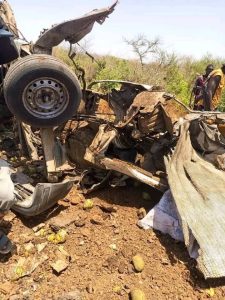
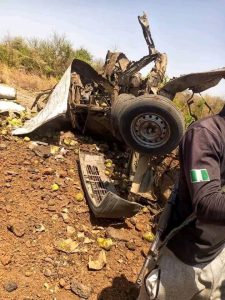
Maiduguri – Two dedicated staff of the Damboa Local Education Authority, Blessing Luka and Gideon Bitterleaf, lost their lives on Monday morning after their vehicle hit an improvised explosive device (IED) allegedly planted by Boko Haram insurgents along the volatile Damboa–Maiduguri highway.
The tragic incident occurred a few kilometers from Damboa town as the victims, travelling in a commercial Toyota Hiace van transporting mangoes to Maiduguri, drove over the hidden explosive. Eyewitnesses confirmed that the two education workers were seated in the front of the vehicle and died on the spot. Several others sustained injuries and were rushed to the State Specialist Hospital, Maiduguri, while the deceased were taken to the morgue.
“This is a devastating loss to our community. Blessing and Gideon were committed public servants who believed in the power of education,” said a grieving colleague at the Damboa LEA.
The Damboa–Maiduguri highway, once a lifeline for commerce and connection, has now become a symbol of death and despair. Stretching about 87 kilometers, this road cuts through a region plagued by more than a decade of insurgency, with repeated attacks attributed to Boko Haram and Islamic State West Africa Province (ISWAP).
From deadly ambushes to landmines and abductions, the road has become notorious for violence. In 2020, a major ambush on a military convoy claimed many lives. Humanitarian agencies have since limited or suspended activities along this corridor due to the extreme insecurity.
“It’s heartbreaking. We risk our lives every time we use this road, yet it’s our only way to access food, education, and healthcare,” said a local commercial driver.
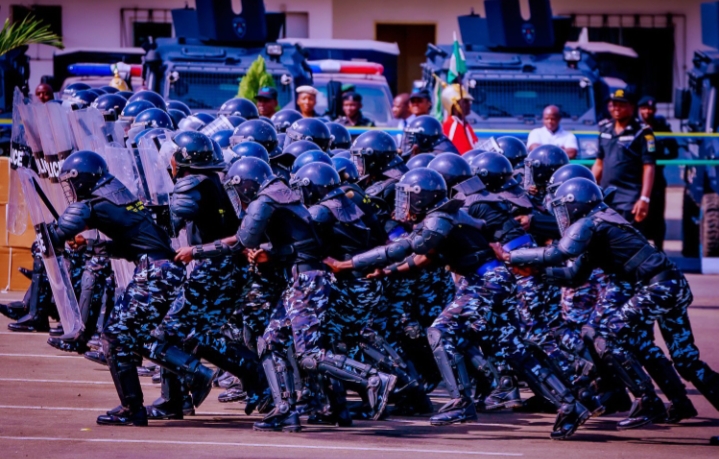
The latest deaths have reignited demands from education stakeholders and community leaders for the Nigerian government to step up protection for civilians in conflict zones. They are calling for immediate deployment of bomb detection teams and increased military patrols to safeguard critical roads like Damboa–Maiduguri.
As of this report, no official response has been issued by the Borno State Government or the Nigerian Army.
Amnesty International has strongly condemned the recent escalation of violence, describing Boko Haram’s deliberate targeting of civilians, including educators and farmers, as clear violations of international humanitarian law and constituting war crimes.
“These brutal attacks, including the use of IEDs on public roads and the systematic killing of civilians, demonstrate Boko Haram’s utter disregard for human life. The Nigerian government must act now to protect civilians and bring the perpetrators to justice,” Amnesty said.
Since March, Boko Haram has intensified its bombing campaign along the Maiduguri–Damboa corridor, killing dozens and spreading terror. The group continues to abduct women and girls, loot communities, and destroy livelihoods.
The insurgency, which began in 2009, has displaced over 2 million people and created a massive humanitarian crisis, particularly in Borno State and around Lake Chad.
The time for decisive action is now. The Nigerian authorities must prioritize civilian protection, ensure justice for victims, and work with international partners to hold Boko Haram accountable for its war crimes.