By faith Chondol
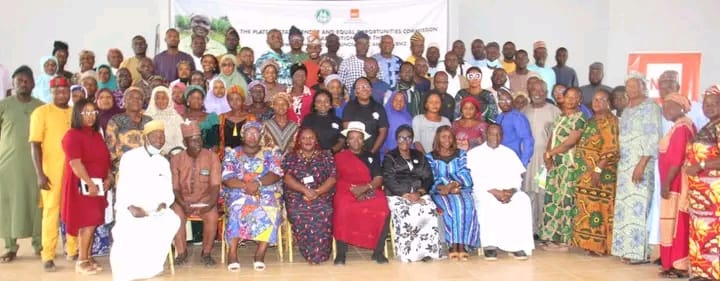
The Plateau State Gender and Equal Opportunities Commission has intensified its advocacy campaign on women and girls’ inheritance rights by taking its sensitisation drive to the Central and Southern zones of the state.

The campaign, organised in collaboration with the Norwegian Refugee Council (NRC), brought together traditional rulers, religious leaders, women leaders, youth representatives and other community stakeholders.
The engagement formed part of a statewide effort to deepen public understanding and support for the proposed Inheritance Rights Bill and reforms aimed at improving women’s access to housing, land and property.
Speaking during the engagement, the Acting Chairperson of the Plateau State Gender and Equal Opportunities Commission and Special Adviser to the Governor on Gender, Barr. Olivia Dazyam, described the campaign as a significant step toward justice, equity and inclusive development in the state.
She commended the Plateau State Government for prioritising gender inclusion and social justice, noting that issues affecting women, children and vulnerable persons are increasingly being placed at the centre of governance.
Dazyam also applauded the Plateau State House of Assembly for the progress made on the proposed Inheritance Bill, which has already passed its second reading. She described the development as a bold move by the state to address long-standing injustices associated with discriminatory inheritance practices.
According to her, the proposed legislation is not intended to undermine culture or religion but to reinforce values of justice, compassion and shared responsibility that are deeply rooted in faith and tradition.
Highlighting the realities faced by many women across communities, the chairperson noted that widows are often dispossessed of their matrimonial homes, daughters denied inheritance solely because of gender, and orphaned children forced out of family properties.
She said denying women and girls access to housing, land and property deepens poverty, destabilises families and weakens community development, stressing that secure property rights for women strengthen families and promote social stability.
Dazyam called on traditional rulers and religious leaders to partner with the commission in addressing harmful practices that perpetuate injustice and poverty. She also encouraged citizens in the Central and Southern zones to participate actively in the upcoming public hearing on the proposed bill.
In a presentation on the legal and policy framework guiding land and property ownership in Plateau State, the Commissioner for Lands, Survey and Town Planning, Barr. Peter Nyam Gai, represented by the Deputy Surveyor-General, Yilcit Adeyanju, highlighted constitutional provisions and state laws that guarantee the right of every citizen, including women, to own property.
He noted that discriminatory customary practices have no legal backing and could hinder economic development.
Also speaking, Ulan Andong, Head of Research and Training representing the Director-General of the Plateau State Microfinance Development Agency (PLASMIDA), Bonkam Wuyep, emphasised that land ownership is central to women’s financial freedom.
He described land as security, identity and capital that enables women to participate effectively in economic activities. According to him, women’s access to land improves household income, supports children’s education, enhances food security and strengthens community stability.
Andong, however, identified challenges such as high land registration costs, bureaucratic delays, cultural resistance and limited awareness of legal rights as barriers to women’s access to property.
He noted that PLASMIDA, in partnership with development organisations, has been advocating reforms including the reduction of land registration costs for women, faster processing of documentation and increased awareness through radio sensitisation campaigns.
The Norwegian Refugee Council (NRC), through its Information, Counselling and Legal Assistance (ICLA) project coordinator, Victor Ayara, also commended Plateau State for taking steps to address harmful cultural practices that limit women’s inheritance and property rights.
Ayara revealed that NRC is supporting the free processing of Certificates of Occupancy for women and has recorded significant progress through collaboration with government institutions, including the Ministry of Lands and Survey.
He also praised the leadership of the commission for advancing practical recommendations that are already producing tangible benefits for women and girls across the state.
During an interactive session, some participants raised concerns based on customary beliefs, questioning the need for girls to inherit family property since women traditionally marry and relocate to their husbands’ homes.
Responding to the concerns, Dazyam clarified that inheritance is a fundamental right and that marriage does not invalidate a woman’s entitlement to family property.
She emphasised the importance of women owning property in their own names, noting that property registered jointly as “Mr and Mrs” may not provide sufficient legal protection for women in cases of conflict, separation, displacement or the death of a spouse.
The commission reaffirmed its commitment to sustained sensitisation and community engagement across all zones of Plateau State, stressing that achieving lasting change will require continuous dialogue, legal awareness and strong partnerships with traditional and religious institutions.



Post Comment