By Palang Paul
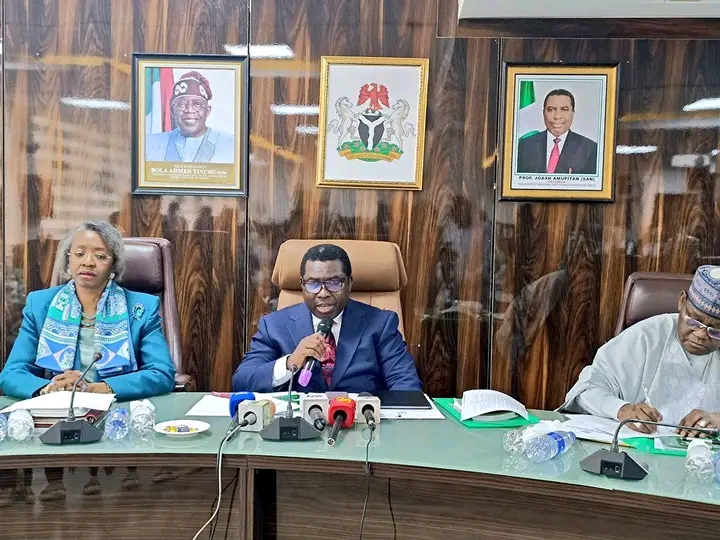
The Chairman of the Independent National Electoral Commission (INEC), Prof. Joash Amupitan, SAN, has defended the Commission’s decision to challenge two recent Federal High Court judgments that questioned aspects of its timetable for the 2027 General Election, warning that conflicting rulings could create uncertainty and disrupt electoral preparations.
Speaking on Tuesday during the Second Quarterly Consultative Meeting with leaders of political parties at INEC headquarters in Abuja, Prof. Amupitan said the Commission had already filed appeals against the judgments and taken steps to obtain definitive interpretations from appellate courts.
According to him, the rulings raised fundamental legal questions regarding INEC’s constitutional authority to coordinate and regulate electoral activities nationwide.
The first judgment, delivered on May 20, 2026, in the case of Youth Party v. INEC, questioned certain timelines contained in the Commission’s electoral schedule. A second ruling in Social Democratic Party (SDP) v. INEC on May 26 affirmed INEC’s power to issue election timetables but struck down some timelines relating to candidate nomination and substitution.
Amupitan argued that the Commission’s timetable comprises interconnected activities critical to the successful conduct of elections and cannot be treated as isolated processes.
He explained that several essential electoral operations—including verification of party membership registers, monitoring party primaries, uploading primary election results, printing ballot papers, configuring BVAS devices, conducting quality assurance checks, and facilitating party inspections of election materials—are not assigned specific timelines under the Electoral Act but must be accommodated within a comprehensive electoral framework.
“The Commission considers it imperative that all electoral activities be harmonised within a coherent and workable framework that promotes certainty, transparency, administrative efficiency and equal treatment of all political parties,” he said.
Despite the ongoing legal battle, the INEC chairman assured stakeholders that preparations for the 2027 General Election would continue in strict compliance with the Constitution and the Electoral Act.
Ekiti Election, Bye-Elections on Course
Amupitan also provided updates on preparations for the Ekiti State governorship election scheduled for June 20, 2026.
He disclosed that the state’s voter register now contains 1,059,360 registered voters, following the addition of 66,664 new registrants through the Continuous Voter Registration exercise. He added that 2,103 cases of double registration had been detected and removed to safeguard the integrity of the register.
The INEC chairman said logistics deployment, training of election officials and technology preparations were progressing as planned, assuring voters that all 2,445 polling units across Ekiti’s 16 local government areas would open simultaneously at 8:30 a.m. on election day.
He further announced that INEC would conduct bye-elections in six constituencies on the same day, including the Enugu North, Nasarawa North, Rivers South-East and Ondo South Senatorial Districts, as well as the Dawakin Kudu/Warawa Federal Constituency in Kano State and the Zuru State Constituency in Kebbi State.
According to him, the same operational standards and security measures being deployed for the Ekiti governorship poll would also apply to the bye-elections.
Parties Receive Portal Access June 26
Looking ahead to the 2027 General Election, Amupitan revealed that political parties would receive official access codes to INEC’s Candidate Nomination Portal on June 26, 2026.
He warned that the portal is fully automated and would close automatically once the submission window expires, urging parties to ensure their ICT personnel and relevant officials are adequately prepared.
The INEC chairman also encouraged political parties to intensify voter education efforts and mobilise eligible Nigerians to participate in the ongoing Continuous Voter Registration exercise.
IPAC Backs INEC, Seeks Electoral Reforms
Responding on behalf of political parties, the National Chairman of the Inter-Party Advisory Council (IPAC), Yusuf Mamman Dantalle, endorsed INEC’s decision to appeal the court judgments, saying the conflicting rulings had generated confusion among political actors and stakeholders.
Dantalle, however, urged the National Assembly to review portions of the Electoral Act 2026, particularly Section 84(2), which limits political parties to either consensus or direct primaries while excluding indirect primaries.
He argued that the provision contributed to disputes during the recently concluded party primaries, alleging that some aspirants were pressured to withdraw in favour of preferred candidates.
“Electoral laws should promote democratic participation, strengthen political institutions, and advance the national interest rather than create avoidable obstacles to effective political competition,” he said.
The IPAC chairman also condemned recent incidents of political violence in Osun State and appealed to political actors to embrace peaceful, issue-based campaigns ahead of upcoming elections.
“No political ambition is worth the loss of human life, the destruction of property, or the destabilisation of communities,” Dantalle stated.




Post Comment