By Mike Odeh James
Abuja


He once entered Aso Rock as an invisible prisoner of a military dictator.
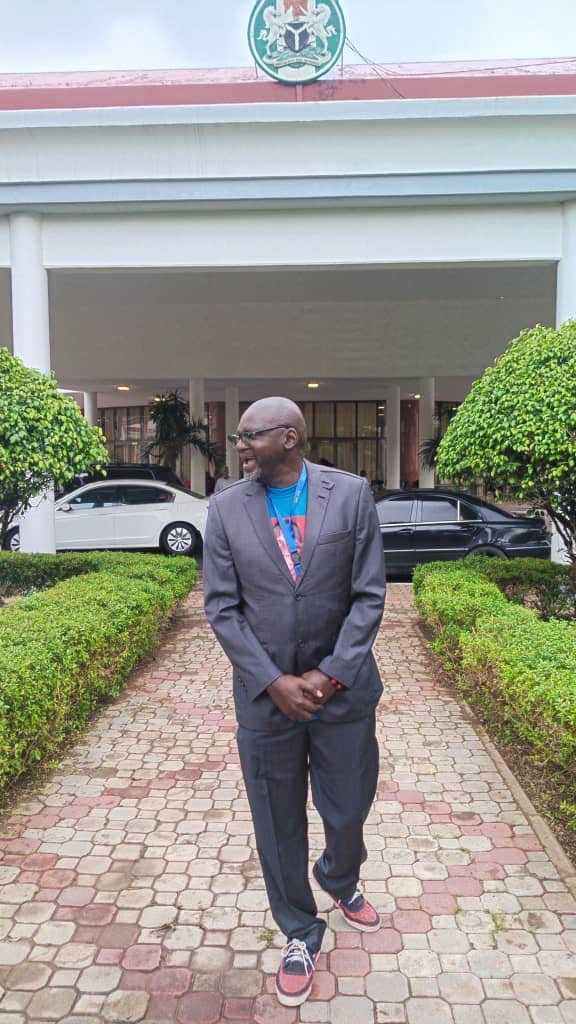
Decades later, Emmanuel Ogebe returned to the same villa to receive one of Nigeria’s highest honors for citizens abroad.
Renowned human rights lawyer Emmanuel Ogebe stood on the glittering podium of the Presidential Villa in Aso Rock, Abuja—the nation’s capital.
Before him sat hundreds of diplomats, government officials, politicians, and Nigerians in the Diaspora, their applause rising in waves across the grand banquet hall.
In that historic moment, Nigeria’s Minister of State for External Affairs, Ambassador Bianca Ojukwu, stepped forward. With a warm smile and measured grace, she presented Ogebe with the nation’s Diaspora merit award.
It was a scene of triumph and redemption—one that sharply contrasted with the memories Ogebe carried from that same villa decades earlier, when he had entered not as a celebrated honoree, but as a secret prisoner of the military dictatorship.
The Morning That Changed Everything
“I want to start by saying this is not my story—it’s His story. I share it for His glory,” Barrister Emmanuel Ogebe recalled in a lecture to a human rights class in the U.S., his voice still steady despite the memories.
Three decades ago, as a young human rights lawyer in Nigeria’s new capital city, Ogebe’s life was dedicated to defending the helpless.
“I moved to Abuja because I felt a need to make an impact in the life of the country,” he says. “I was practicing law, representing a few missionaries as my clients.”
One morning, those missionaries came to his home bearing life-shattering news:
“The wife of the president-elect—who was imprisoned—was driving to the Canadian Embassy when she was assassinated in broad daylight,” Ogebe remembers.
The victim was Kudirat Abiola, a woman who had only wanted her husband, Chief MKO Abiola, released from military detention.
“I broke down and cried. I sobbed like a child. This woman didn’t ask for any of this. She was just trying to get her husband back. And they killed her.”
Defying a Dictator
Shaken, Ogebe acted swiftly. He drafted a press statement and a personal letter to the military Head of State:
“I told him the killing of this woman showed insecurity in the country. I demanded that he investigate and bring the killers to account.”
With no email or social media back then, Ogebe went to the government post office to fax his letter directly to the dictator. He also gave copies to the press. In his rush, he forgot his wallet and promised the post office staff he would return the next day to pay.
The next morning, he decided to keep his word.
“When I walked in, the staff looked uneasy. I paid my bill and noticed them stalling. Then one walked to block the door. I spoke in their local language: ‘Is this how you will betray me?’”
The woman froze. She turned to her colleague and whispered, ‘Is he one of us?’ Moments later, soldiers stormed the building.
Vanishing into the Presidential Villa
He was taken to the manager’s office.
“Are you the one who sent that fax yesterday?” the manager asked.
“Yes, I did,” Ogebe replied calmly.
The manager explained that the secret police had visited the previous day, arrested his staff, and only released them when they insisted they had no control over public faxes. They however mentioned that the person who faxed it was coming back to pay his bill but the military disbelieved them.
“They assumed I’d never return to pay. But when I showed up, they called the presidential villa. Soldiers were already on their way.”
From there, he was driven straight to Nigeria’s most heavily guarded fortress—the presidential villa.
“At the gate, there’s always a manifest—a list of those cleared to enter. I had been on that list many times because I had top clients in government. This time, I wasn’t on it. But when they said I was a prisoner, they waved me through. I realized then—I had become the invisible man.”
Torture and Fear
Inside, the interrogation began.
“Do you know who killed that woman? Why did you write to the Head of State?”
Before long, soldiers were beating him with rods and sticks.
“They tortured me for hours. Then the OC ordered them to search my house and warned, ‘If he tries to escape, waste him.’”
At that time, Ogebe had been on a one-week fast. Soldiers mistook his refusal to eat as a hunger strike.
“After a couple of days of torture and fasting, I passed out. The next thing I knew, I was being dragged into a hospital. It was all part of their method—to break you, make you talk.”
A Divine Breakthrough
Back at the villa’s guardroom, a guard recognized his name.
“Oh my goodness, this is Barrister Emmanuel Ogebe—my boss’s lawyer!”
The guard promised to inform his superior but Ogebe knew better:
“Dictators don’t care how connected you are. My only hope was for him to alert my family.”
Ogebe cleverly used his checkbook to send a coded message: he sent a check through him to the family’s bank manager, who immediately realized from the date that it was from while he missing.
“That was how my family finally learned where I was. It was nothing short of divine intervention.”
Life in a Cramped Cell
After days of secret detention, he was moved to a small police-station prison.
“The cell was meant for four people. We were over a dozen, lying like sardines on the bare cement floor. The toilet was inside the cell—filthy and stinking. There were no baths. Yet, the worst part was knowing I wasn’t a criminal and might never leave. I was a prisoner of the Head of State himself.”
Among the inmates were four “state house prisoners”—people jailed on the president’s personal order. “We were treated differently because guards feared we might regain influence. But that fear also meant we could disappear forever.”
One day, a journalist disguised as a clergyman interviewed him in the cell. Soon after, the front-page story screamed: “Judge’s Son Imprisoned by General Abacha Over Kudirat’s Death.”
“The dictator was furious. He banned all my visitors. Even the little privileges I had disappeared.”
When God Spoke in the Darkness
In the darkest moments, faith became his anchor.
“One night, I heard God clearly for the first time: ‘Your term will be two months.’
I woke up amazed because, as a lawyer, I knew a prison term means a defined sentence. I had none.”
True to that voice, two months after his arrest, a letter arrived from the villa: two state house prisoners were to be released—Ogebe and Mohammed.
“It was in that cell, not in a church with hands lifted high, that I heard God for myself. That experience is priceless.”
A Life Forever Changed
Ogebe emerged from prison a transformed man. His father, a judge, had hoped he would pursue a conventional legal career, but the experience cemented his calling as a human rights defender.
“God showed up for me in that cell. I would never trade that encounter for a million years,” he says quietly.
Today, his story remains a testament to fiery faith forged in the flames and the quiet power of conviction and vindication in the face of faded tyranny.
And God showed up again, Ogebe believes, in another epic soccer comeback just like his award banquet across from his former prison.