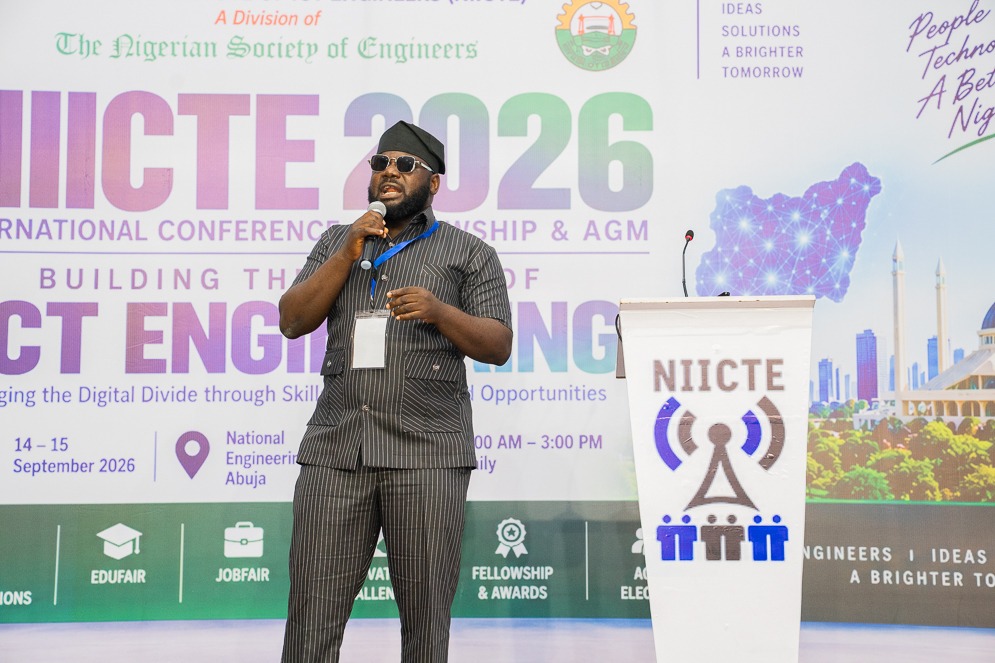
ABUJA — Kaduna-based artificial intelligence developer and software engineer, Samuel Ateh Stephen, has called for a shift from viewing artificial intelligence merely as a tool for generating text and answering questions to deploying it as part of the actual operating infrastructure of businesses and institutions.
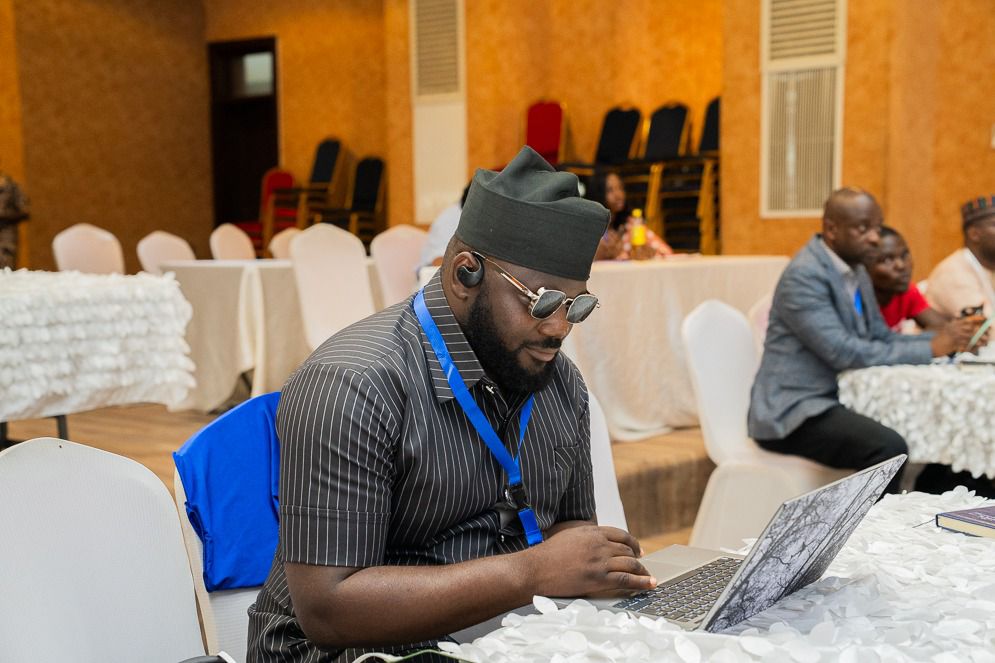
Stephen, Founder and Chief Executive Officer of Realist Tech Solutions (RTS), made the call while speaking at the 2026 International Conference, Fellowship and Annual General Meeting of the Nigerian Institute of ICT Engineers (NIICTE) held at the National Engineering Centre, Abuja.
The two-day gathering brought together ICT engineers, technology professionals, industry leaders and other stakeholders to examine emerging opportunities within Nigeria’s digital economy.
NIICTE, a specialized division of the Nigerian Society of Engineers, organised the conference around the theme, “Building the Future of ICT Engineering: Bridging the Digital Divide through Skills, Innovation and Opportunities.”
Stephen’s presentation focused on an emerging model he described as “One Person. One Laptop. One AI-Powered Company.”
Rather than limiting the session to a conventional presentation on artificial intelligence, the Kaduna technologist demonstrated a functioning AI-native business operating system developed by RTS.
Using a simulated company known as Meridian Integrated Services, Stephen showed how a customer request could enter an organisation and be processed by a coordinated AI workforce performing different business functions, including client services, procurement, operations, commercial analysis, documentation and communications.
The demonstration also featured an AI Chief of Staff capable of briefing management on an active business request, identifying areas requiring attention and presenting information from across the organisation to support executive decision-making.
A key element of the demonstration was the retention of human control over consequential decisions.
The AI workforce was allowed to analyse requirements, coordinate tasks, prepare commercial information, generate business documents and prepare communications, but the system was designed to stop at the point where management approval was required.
According to Stephen, the future of enterprise AI should not be built around removing human accountability but around giving capable people access to significantly greater operational capacity.
He argued that the more important question facing organisations is gradually moving beyond “What can AI answer?” to “How much organisational capacity can one competent human direct when intelligence, tools, systems and governance are properly combined?”
The live session demonstrated a workflow in which a business request moved from customer intake to operational execution, executive briefing, human approval and eventual external action.
Stephen said the concept represents a movement away from isolated AI chatbots toward intelligent systems that understand organisational context, operate within defined permissions and interact with existing business tools.
At the centre of the model, he explained, is the principle that AI systems may execute significant portions of organisational work while humans continue to provide direction, authority and accountability.
The presentation drew strong interest from participants, particularly because the concept was demonstrated as a working system rather than presented only as a theoretical model.
For Stephen, Nigeria’s growing conversation around artificial intelligence should increasingly focus on building locally relevant systems that address practical institutional and economic challenges.
He maintained that Nigerian developers and technology companies should not restrict themselves to consuming foreign AI products, but should explore how existing artificial intelligence capabilities can be engineered into solutions for businesses, government institutions, education, infrastructure, research and public service delivery.
The RTS founder also believes that the next stage of AI adoption will require stronger collaboration between software developers, professional engineering bodies, businesses, policymakers and institutions.
Such partnerships, he noted, could help move the country from general conversations about AI adoption toward measurable applications capable of improving productivity, institutional capacity and service delivery.
Realist Tech Solutions, which operates from Kaduna, has been developing AI, software and institutional intelligence systems with a focus on combining human strategy with artificial intelligence and digital systems.
Stephen’s appearance at the NIICTE conference adds to a growing push by young technology builders outside Nigeria’s traditional technology hubs to participate more actively in shaping the country’s emerging AI and digital transformation ecosystem.
For Kaduna in particular, the development also offers another indication of the technology talent and innovation capacity emerging from the state.
As artificial intelligence continues to transform the global technology landscape, Stephen believes Nigeria’s competitive advantage will depend not simply on access to AI models, but on the country’s ability to engineer those capabilities into systems that solve real problems.
His message at the Abuja gathering was ultimately straightforward:
AI should not merely help people talk about work. It should increasingly help organisations get real work done — under clear human direction and accountability.





Post Comment